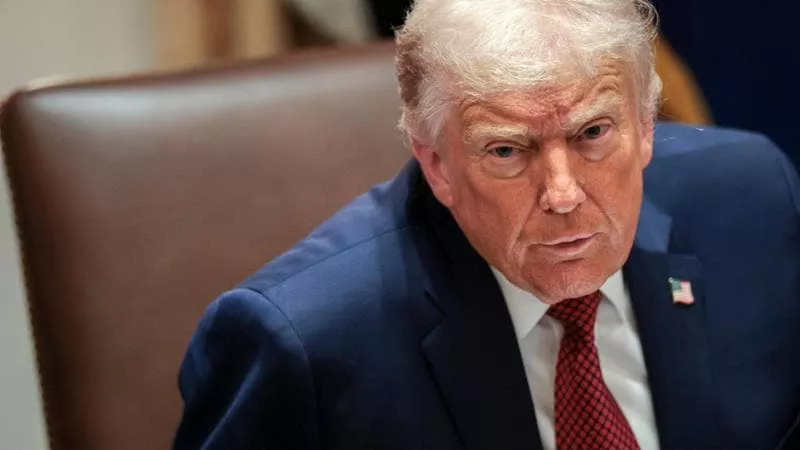

US President Donald Trump repeated his call for Iran to “make a deal” on its nuclear program or face “the worst attack ever,” more severe than last year’s attacks when US and Israeli airstrikes targeted Iranian nuclear facilities.
Trump has threatened military strikes against Iran after a brutal crackdown on anti-government protests that rights groups and eyewitnesses say left thousands dead.
The United States has in recent days deployed fighter jets, air defense systems and what Trump has called a “fleet” to the Middle East, a move that has heightened tensions with Iran and increased the likelihood of military action, according to experts.
“We hope that Iran will come ‘to the table’ quickly and negotiate a fair and equitable deal – WITHOUT NUCLEAR WEAPONS – a deal that is good for all parties,” Trump said in a social media post on January 28.
“Time is running out! As I told Iran before, MAKE A DEAL! They didn’t, and Operation Midnight Hammer happened, a major blow to Iran. The next attack will be much worse!”
US Central Command announced on January 27 that a US aircraft carrier group, led by the USS Abraham Lincoln, was in Middle Eastern waters.
Speaking before Trump’s statements, the Iranian foreign minister said negotiations with Washington cannot take place in an atmosphere of military threats.
Abbas Araqhchi, according to state media ISNA, said on January 28 that “exercising diplomacy through military threat cannot be effective or beneficial.”
He added that he had had “no contact” with US envoy Steve Witkoff in recent days and that “Iran has not asked for negotiations.” Trump, on the other hand, said in an interview with Axios on January 26 that Tehran had “called on many occasions.”
Economic crisis
Iran has been embroiled in unrest since December 28, 2025, when peaceful protesters began taking to the streets of Tehran to demand that authorities stop inflation and currency devaluation.
The clashes spread across the country and turned into a broader anti-government movement, prompting a massive and deadly response from the authorities that sparked outrage around the world.
The US-based human rights organization HRANA, which Radio Free Europe/Radio Liberty has quoted regularly since the start of the violent crackdown in Iran this month, reports that the number of confirmed victims, including on the side of security forces, is 6.221, while the number of deaths still under investigation is 17.091. More than 42.000 people have been arrested.
Some media outlets, citing unidentified officials, have reported that the death toll is much higher.
The failed nuclear deal
In 2015, Iran agreed to a historic deal with world powers, aimed at preventing the Islamic Republic from developing a nuclear weapon in exchange for easing economic sanctions.
But he began to backtrack on his commitments after Trump, during his first presidential term, withdrew the United States from the deal in 2018 and reimposed sanctions on Tehran.
Iran suspended cooperation with the International Atomic Energy Agency in July 2025, in response to US and Israeli bombings of key nuclear facilities in Fordow, Isfahan, and Natanz.
Sanctions related to the nuclear deal and other issues have severely damaged the Iranian economy, which has occasionally sparked protests due to rising prices and shortages of goods and energy supplies.
The latest protests are widely seen as the biggest challenge to the Islamic Republic since the 1979 revolution.