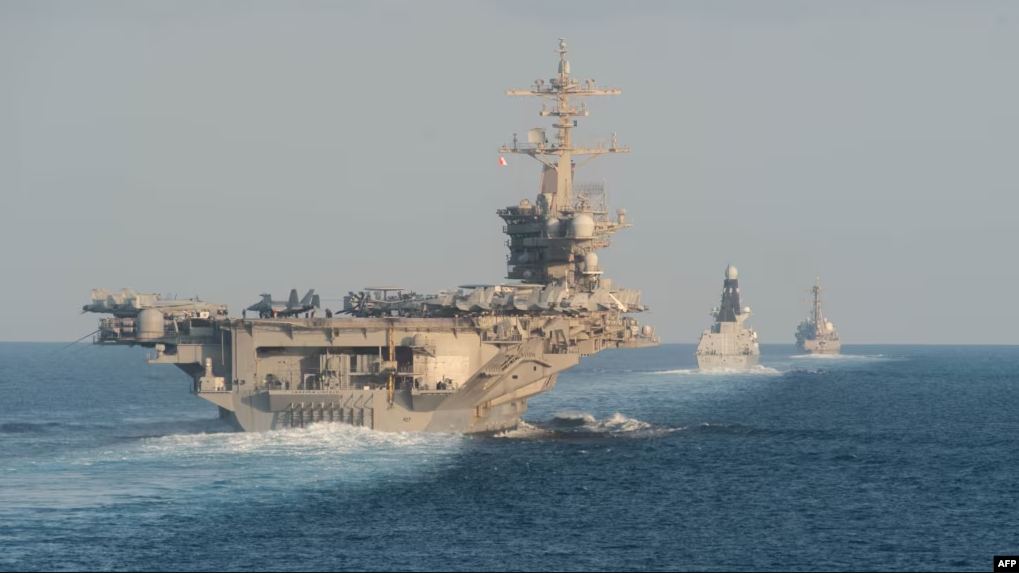

A US aircraft carrier strike group arrived in the Middle East on January 27, as tensions rise over a possible attack on Iran after a brutal crackdown on protests that rights groups say has left thousands dead.
Amid the unrest, the Iranian currency, the rial, fell to its lowest level against the dollar, trading at 1.5 million rials on January 27.
US President Donald Trump said he “hopes” military action against Iran will not be needed, but he has also sent a “fleet” to the region, refusing to rule out air strikes in response to the crackdown on mostly peaceful protesters who took to the streets in recent weeks to demand action to stop inflation and currency devaluation.
The US-based human rights organization HRANA says the confirmed death toll, including security forces, has now reached 6.126, while the number of victims still under investigation is 17.091.
Some estimates from officials unofficially quoted by various media are several times higher.
US President Donald Trump told Axios in an interview on January 26 that the situation with Iran is “changing” because he has sent a “large fleet” to the region, with a strike group led by the aircraft carrier USS Abraham Lincoln already in Middle Eastern waters, according to US Central Command.
But Trump added that he thinks Tehran really wants to reach a deal.
“They want to make a deal. They’ve called us on several occasions. They want to talk,” Trump was quoted as saying.
The protests began on December 28 in the markets of the Iranian capital, Tehran, amid anger among merchants over dire economic conditions. The demonstrations quickly spread across the country and turned into protests against the authorities over deteriorating living standards and the suppression of freedoms.
The rial’s decline against the dollar comes at a time when the annual inflation rate has reached 44.6 percent, including a nearly 90 percent year-on-year increase in food prices. Iran’s economy has struggled for years due to international sanctions and the aftermath of the 12-day war it waged with Israel in June last year.
Eyewitness accounts and verified reports from human rights organizations appear to indicate that the violent crackdown peaked on January 8 and 9, when security forces opened fire on protesters.
Amid a weeks-long internet shutdown, information about the true extent of the violent suppression of protests continues to gradually emerge.
The monitoring group, NetBlock, in its daily report published on January 26, said that the interruption of internet access continues, although there were reports of limited internet access.
An Iranian government spokesman said on January 27 that internet access was halted to “preserve people’s lives,” although he did not explain what he meant by this statement.
However, new images of the crackdown continue to emerge online, as Iranians try to show how severe the violent response was.
The Vahid Online channel published new images showing government forces firing directly at protesters in the town of Amol on the evening of January 9, contradicting authorities’ claims that the killings were carried out by “terrorists” and not state security agents.
In these images, uniformed officers armed with Kalashnikov rifles are seen targeting the streets and shooting./