Every football fan has heard someone at a match or in a café shout that a goal should not have counted because a player was offside. Explaining the rule properly is harder. Yet the principle is simple, and knowing a few details makes watching the game more enjoyable.
The basic idea
The offside rule stops attackers from waiting next to the opponents’ goal for a long ball. It forces teams to build attacks and gives defenders a way to control space by moving up the pitch together.
When is a player in an offside position?
A player is in an offside position if, at the moment a teammate plays the ball, any part of their head, body or feet is in the opponents’ half and closer to the opponents’ goal line than both the ball and the second-last opponent. The goalkeeper usually counts as one of the last two opponents. Arms and hands are not counted, so a player cannot be offside because of an outstretched arm.
A player level with the second-last opponent, or level with the ball, is not in an offside position.
Being in the position is not an offence
Standing in an offside position is not punished on its own. It becomes an offence only if the player becomes involved in active play, by playing or touching the ball, by interfering with an opponent, for example blocking the goalkeeper’s line of sight, or by gaining an advantage, such as playing a ball that rebounds off the post or the goalkeeper.
Exceptions
There is no offside offence if a player receives the ball directly from a goal kick, a throw-in or a corner kick. A player is also not offside when the ball comes from a deliberate play by an opponent, other than a save, though this area has produced some controversial decisions.
Why it is so hard to judge
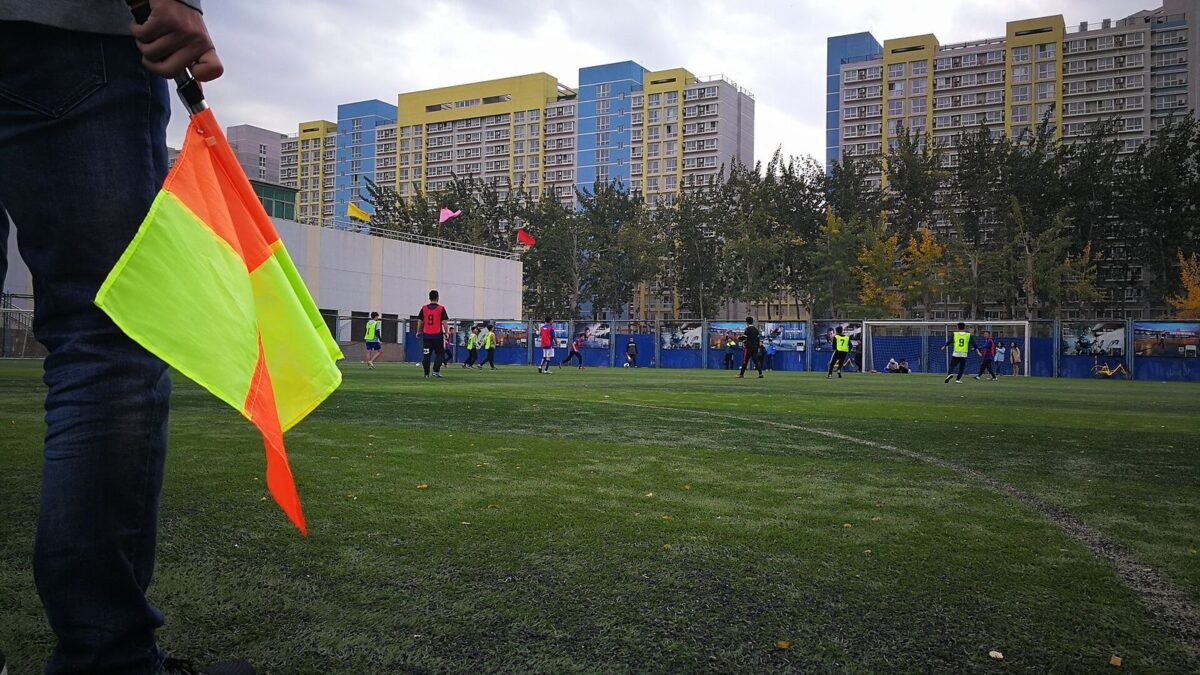
Assistant referees must watch two moments at once: the instant the ball is played and the positions of attackers and defenders, often 30 metres apart and moving at full speed. Video technology now measures positions precisely, which has removed some errors but created arguments about tiny margins. Football’s law-makers have discussed changes to give more benefit to attackers, but for now the basic rule remains as described here.


