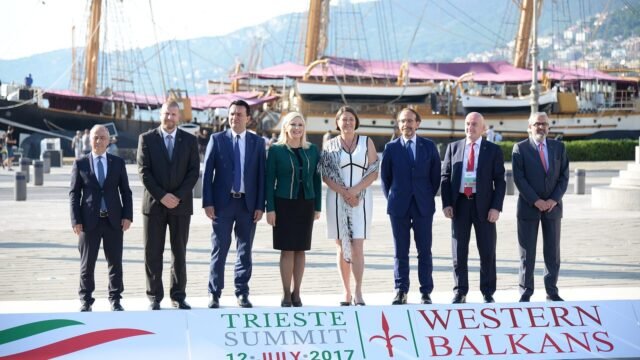
Croatia became the European Union’s 28th member state in July 2013. It remains the last country to join. In the years since, six Western Balkan countries (Albania, Bosnia and Herzegovina, Kosovo, Montenegro, North Macedonia and Serbia) have been told repeatedly that their future lies inside the bloc. Yet the journey from that promise to a seat at the table is long, technical and, at almost every stage, political.
Understanding how enlargement actually works helps explain why progress can stall for years and then suddenly accelerate, and why the same news can sound like a breakthrough in one capital and like a formality in another.
The entry ticket: the Copenhagen criteria
Any European country can apply, but to become a member it must meet the conditions agreed by EU leaders in Copenhagen in 1993. They fall into three groups: stable institutions guaranteeing democracy, the rule of law and human rights; a functioning market economy able to cope with competition inside the single market; and the ability to take on the obligations of membership, which means adopting and enforcing the EU’s body of law, known as the acquis.
A country first applies, then receives candidate status if member states agree, and only later opens formal accession negotiations. Each of those steps has, in practice, taken years for Balkan applicants. Montenegro became a candidate in 2010 and opened negotiations in 2012. Serbia began talks in 2014. Albania and North Macedonia opened negotiations in July 2022, after a long delay caused by objections from individual member states. Bosnia and Herzegovina was granted candidate status in December 2022, while Kosovo submitted its application the same month and is still considered a potential candidate.
Chapters and clusters
The negotiations themselves are organised into 35 chapters, each covering a policy area: from free movement of goods and competition policy to food safety, energy, taxation and justice. In 2020 the EU revised its method and grouped these chapters into six clusters, so that related reforms move together. The first cluster, called “Fundamentals”, covers the judiciary and fundamental rights, justice, freedom and security, public procurement, statistics and financial control.
The fundamentals cluster is opened first and closed last. In plain terms, a country cannot finish its negotiations until the EU is satisfied that courts are independent, corruption is being prosecuted and public money is properly controlled. For the rule-of-law chapters, numbered 23 and 24, the EU sets “interim benchmarks” that must be met before any chapter can be provisionally closed. That is why Montenegro’s positive assessment on those benchmarks in 2024 was treated as a turning point: it opened the door to closing chapters, the stage at which negotiations begin to look like a finish line.
Why unanimity matters
Enlargement is one of the few areas where the EU still decides almost everything by unanimity. Opening a cluster, closing a chapter and approving the final accession treaty all require the consent of every member state. After the treaty is signed, it must also win the consent of the European Parliament and be ratified by each member state according to its own constitutional rules, which can include a referendum.
This gives every government a veto, and vetoes have frequently been used over issues that have little to do with the technical chapters. North Macedonia changed its constitutional name in 2019 to resolve a long dispute with Greece, and later faced objections from Bulgaria over history and language. Such disputes can freeze a country’s progress regardless of how many reforms it has completed.
Money and the “Growth Plan”
Alongside negotiations, the EU funds reforms through its Instrument for Pre-accession Assistance. In late 2023 it added a Growth Plan for the Western Balkans, backed by a Reform and Growth Facility worth around six billion euros for 2024–2027. The idea is to give the region gradual access to parts of the single market before full membership, and to release money only when agreed reforms are delivered. Supporters see it as a way to make the benefits of integration visible to citizens much earlier; critics warn that a partial integration could become a substitute for membership rather than a path to it.
What it means for citizens
For people in the region, the effects of the process are felt long before membership. Laws on consumer protection, food standards, public procurement and data protection are rewritten to match EU rules. Students and researchers take part in EU programmes. Visa-free travel to the Schengen area, which citizens of Kosovo gained in January 2024, was itself the result of a separate reform process tied to EU standards.
At the same time, the slow pace has a cost. Surveys in several Balkan countries show that support for membership remains high but that many people doubt it will happen in their lifetime. Emigration of young and skilled workers to EU countries continues, partly because the benefits of integration are easier to reach by moving than by waiting.
What to watch next
The most useful indicators are not speeches but procedural steps: the opening of clusters, the meeting of interim benchmarks on the rule of law, and the provisional closing of chapters. Montenegro is widely regarded as the frontrunner, with Albania moving quickly since its talks opened. Serbia’s progress depends heavily on its alignment with EU foreign policy and on normalisation with Kosovo, while Bosnia and Herzegovina still needs to complete key reforms before talks can begin in earnest.
The EU itself is also debating whether it must reform its own decision-making before it grows further, including whether some decisions should move away from unanimity. That debate may ultimately matter as much to the Western Balkans as any reform passed in their own parliaments.