In August 2014, Germany invited the leaders of the six Western Balkan countries to Berlin. The timing was not accidental. The European Commission had just signalled that no new members would join during its mandate, and there was a risk that the region would drift. The meeting was meant to keep cooperation going while membership stayed distant. It became an annual event, and it is now known as the Berlin Process.
Who takes part
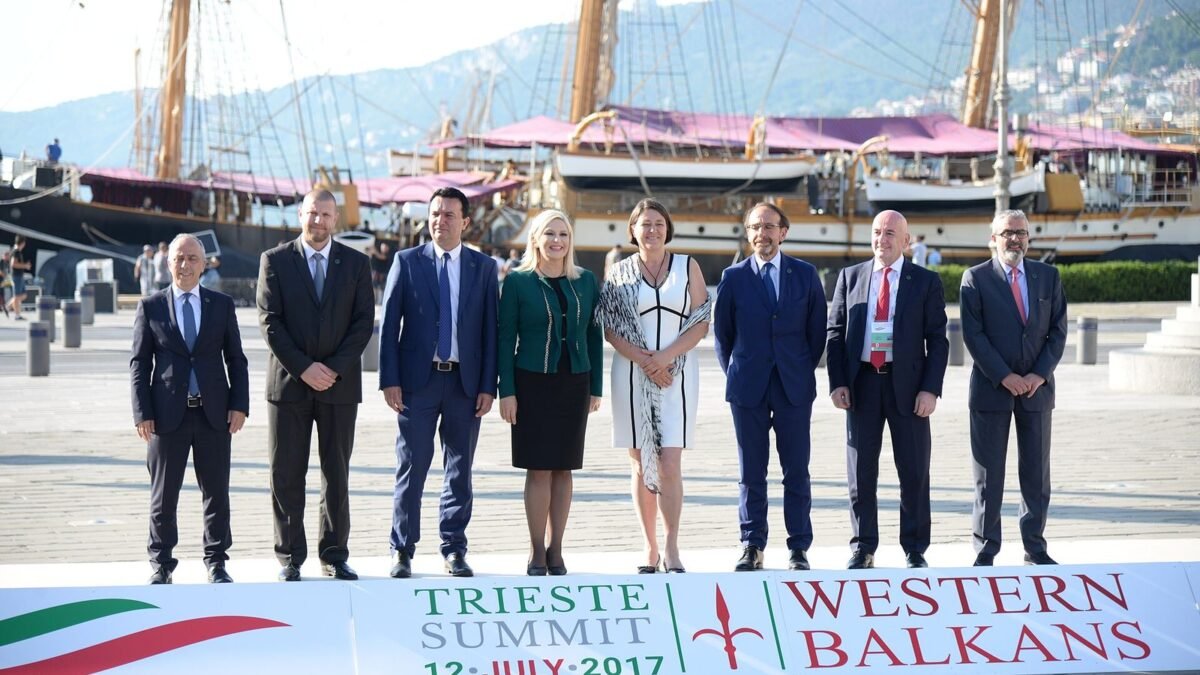
The core group is the “Western Balkans Six”: Albania, Bosnia and Herzegovina, Kosovo, Montenegro, North Macedonia and Serbia. Alongside them sit several EU member states, the European Commission and international financial institutions. Summits have been hosted in Vienna, Paris, Trieste, London, Poznań, Sofia and Berlin. In 2023 Tirana became the first city in the region itself to host the summit.
The Berlin Process is not an EU institution and it has no treaty behind it. It works through political commitments, regional agreements and money for specific projects.
What it has delivered
Connectivity. The early focus was on roads, railways and energy links. A package of infrastructure projects, partly financed by EU grants, was agreed under what was called the Connectivity Agenda. Some of those projects have been built. Others are still on the drawing board.
Roaming. The regional roaming agreement led to the end of roaming charges between the six countries in July 2021. For ordinary people it is probably the most visible result.
Young people. The Regional Youth Cooperation Office, known as RYCO, was set up with headquarters in Tirana. It funds school and youth exchanges between the six countries, often bringing together young people who would otherwise never meet.
Travel and recognition. At the 2022 summit in Berlin, leaders signed agreements allowing citizens to travel across the region with only an identity card and to have university diplomas and some professional qualifications recognised. Ratification has been slow, and not every country applies them fully.
The Common Regional Market
In 2020 the leaders endorsed the idea of a Common Regional Market, inspired by the EU’s single market. It aims at freer movement of goods, services, capital and people within the region. Progress has been uneven, and disagreements, especially between Belgrade and Pristina over issues such as documents and names, have blocked or delayed several steps.
Why critics are frustrated
Critics say the process produces declarations more easily than results. Infrastructure projects can take years, agreements often wait for ratification, and political disputes between neighbours spill into technical work. Others argue that the Berlin Process was never meant to replace enlargement, only to keep the region connected while it waits.
Why it still matters
For all its limits, the Berlin Process is one of the few places where all six leaders sit at the same table with EU partners every year. It has delivered changes people notice in daily life, such as cheaper phone bills abroad and easier travel. Whether it becomes a real bridge to EU membership depends less on the format and more on what governments in the region, and in Brussels, decide to do next.