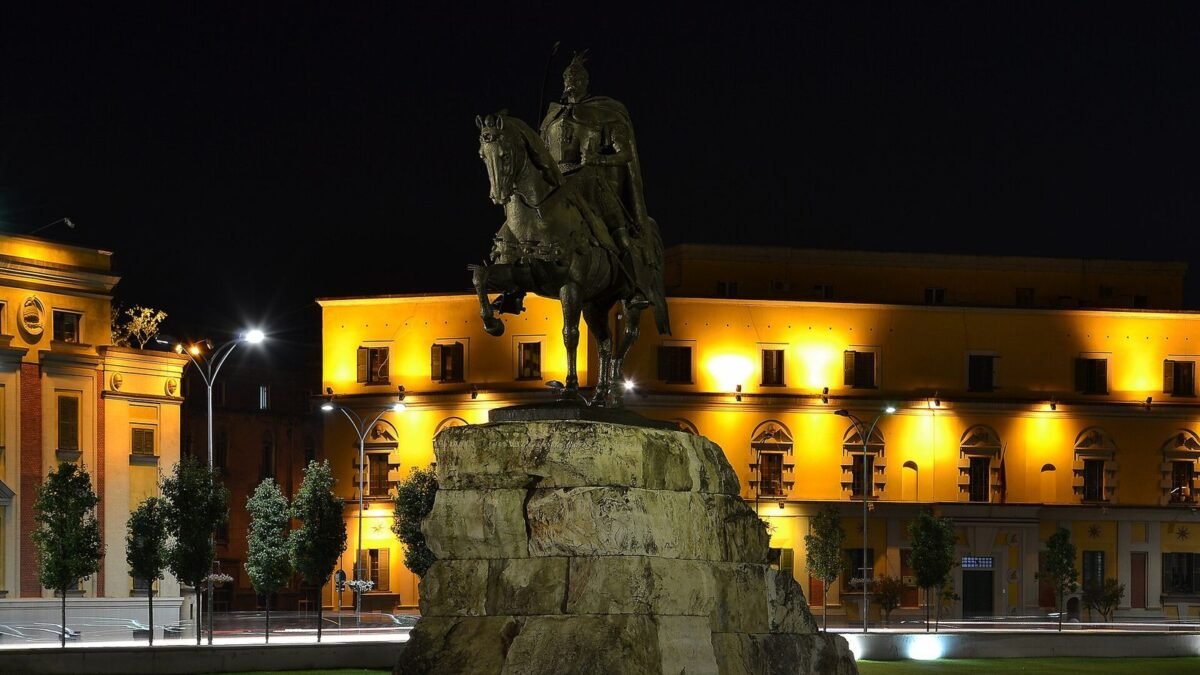
His statue stands in the main square of Tirana, his helmet with the goat’s head is a national symbol and his name appears on streets from Pristina to Skopje. Gjergj Kastrioti, known as Skanderbeg, is the central figure of Albanian national memory. The real man, as historians reconstruct him, is no less remarkable than the legend.
A hostage who changed sides
Born around 1405 into the Kastrioti family, regional lords in northern Albania, Gjergj was sent as a young man to the Ottoman court, a common practice for securing the loyalty of local rulers. He converted to Islam, served in the Ottoman army and received the name Iskender, Alexander, and the title bey, which together became Skanderbeg.
In 1443, during an Ottoman defeat at Niš, he left the army, returned to Albania, seized the fortress of Krujë and renounced Islam. The following year, in 1444, he brought together Albanian nobles in the League of Lezhë, an alliance that gave him military leadership.
Twenty-five years of resistance
For about twenty-five years Skanderbeg resisted repeated Ottoman campaigns, including large sieges of Krujë in 1450 and 1466-67 led in part by Sultans Murad II and Mehmed II, the conqueror of Constantinople. He relied on mountain terrain, mobile cavalry and surprise attacks, and sought support from Venice, Naples and the Pope, who praised him as a defender of Christendom.
He died of illness in Lezhë in January 1468. Krujë held out for another decade before falling to the Ottomans in 1478.
Where legend takes over
Much of what later generations believed came from a biography written around 1508-1510 by Marin Barleti, a priest from Shkodër. Barleti’s Latin work spread Skanderbeg’s fame across Europe but included dramatic speeches and exaggerated numbers typical of Renaissance writing. Historians use it carefully alongside Venetian, Ottoman and papal archives.
In the 19th century, writers of the Albanian national awakening, such as Naim Frashëri, made Skanderbeg a symbol of unity across religions and regions. Under communism he was presented as a hero of resistance against foreign domination.
A shared symbol
Today, Skanderbeg remains one of the few figures celebrated by Albanians of all faiths and in every country where they live. Whatever the debates among historians, his story continues to answer a question every nation asks: where do we come from, and what did we resist to stay ourselves?


