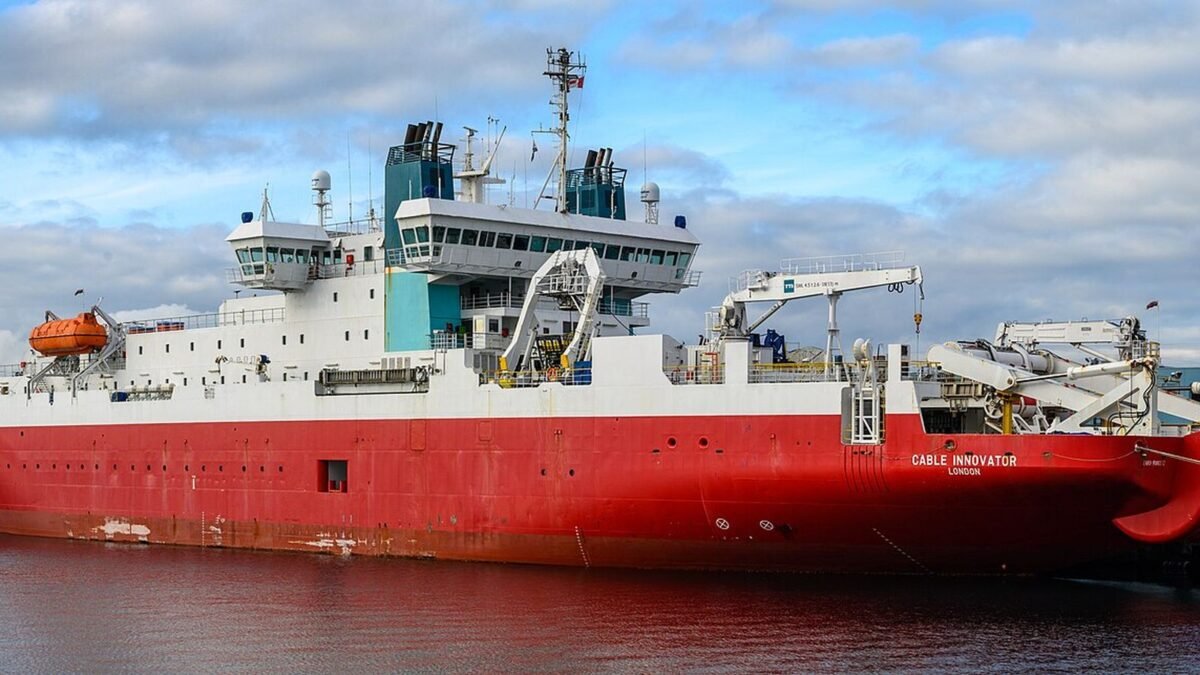
When you send a message to a relative in the United States or watch a video stored on a server in Ireland, the data almost certainly does not travel through space. It travels through glass fibres inside cables lying on the bottom of the sea. Submarine cables carry the overwhelming majority of international internet traffic, yet most people have never heard of them.
What a cable looks like
A modern submarine cable is surprisingly thin, often about the width of a garden hose in deep water. At its core are pairs of optical fibres, each thinner than a human hair, through which data travels as pulses of laser light. Around the fibres are layers of protection: a metal tube, copper to carry electrical power, insulation and, near the coast, heavy steel armour to protect against anchors and fishing gear.
Light weakens as it travels, so long cables include repeaters every several dozen kilometres. These devices, powered through the cable itself, boost the signal so it can cross entire oceans.
How they are laid
Specialised cable ships carry thousands of kilometres of cable in giant tanks. Before laying, engineers survey the seabed to avoid steep slopes, volcanic areas and busy fishing grounds. In deep water, the cable simply rests on the seabed. Closer to shore, it is buried in a trench to protect it. At each end, the cable reaches a landing station, a building that connects it to national networks.
Why satellites do not replace them
Satellite internet has improved a lot, especially for remote areas and ships. But fibre cables carry far more data, with lower delay, at lower cost per bit. For the huge volumes moved between continents and data centres every second, cables remain the backbone.
Breaks and repairs
Cables are damaged regularly, most often by ship anchors and fishing trawlers, and sometimes by earthquakes and underwater landslides. When a cable is cut, traffic is usually rerouted through other cables, so users may notice only slower connections. Repair ships locate the damage, lift the cable to the surface, splice in a new section and lower it again. Depending on weather and location, this can take days or weeks.
A security question
Because so much depends on so few cables, governments increasingly treat them as critical infrastructure. Several unexplained cable cuts in European waters in recent years have led to more naval patrols and debates about protection. Countries also care about who builds and owns new cables, since landing stations are strategic points in a nation’s connectivity.
The Balkans and the cables
Countries on the Adriatic and the Mediterranean connect to the global network through cables landing on their coasts, which then link inland to neighbouring countries. For the region, more cable routes mean more resilience: if one link fails, traffic can find another way. Every video call to the diaspora depends, in the end, on these quiet lines on the seabed.