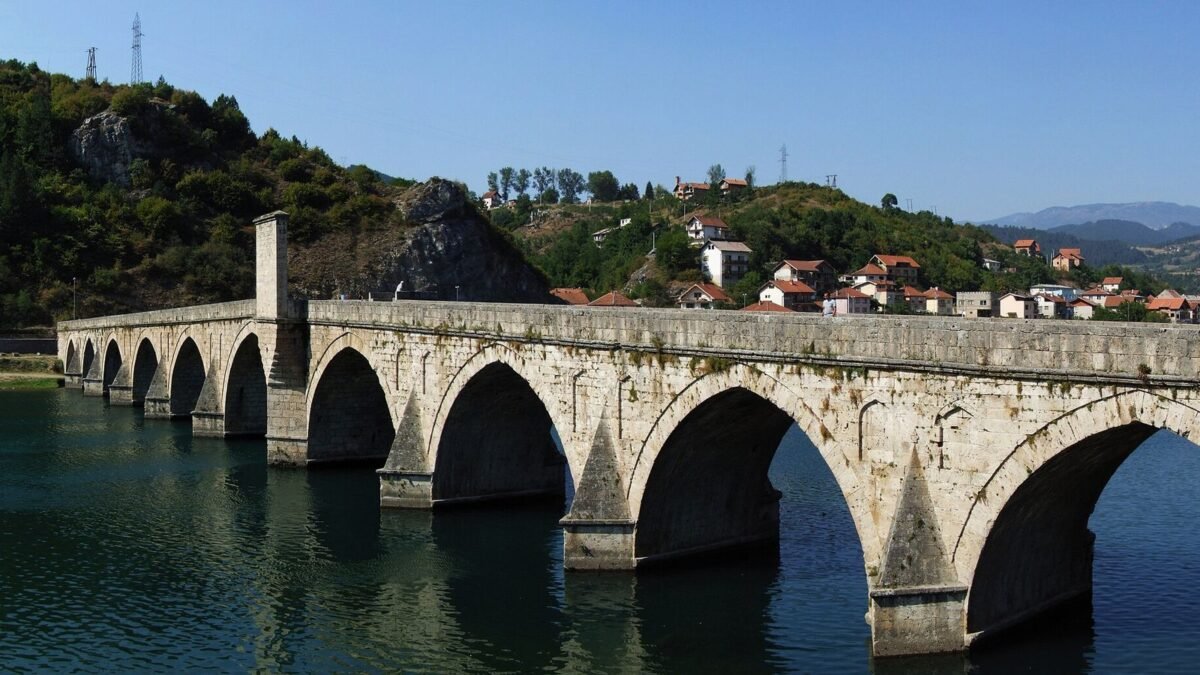
In the eastern Bosnian town of Višegrad, an Ottoman stone bridge with eleven arches crosses the Drina river. It was built in the sixteenth century on the orders of the grand vizier Mehmed Pasha Sokolović and designed by the great architect Mimar Sinan. Four centuries later it became the centre of The Bridge on the Drina, the best-known novel by Ivo Andrić, the only writer from the former Yugoslavia to win the Nobel Prize in Literature.
Who was Ivo Andrić?
Andrić was born in 1892 near Travnik, in Bosnia, then under Austro-Hungarian administration. He grew up partly in Višegrad, studied in several European cities and, as a young man, was imprisoned by the Austrian authorities for his links with the South Slav nationalist movement. Between the two world wars he had a long diplomatic career for the Kingdom of Yugoslavia, serving in several European capitals.
During the Second World War he lived quietly in Belgrade and wrote. In a short period he completed three novels, published in 1945: The Bridge on the Drina, Bosnian Chronicle (also known as Travnik Chronicle) and The Woman from Sarajevo. In 1961 he was awarded the Nobel Prize in Literature. He died in Belgrade in 1975.
A novel about a bridge
The Bridge on the Drina covers almost four hundred years, from the construction of the bridge in the sixteenth century to the beginning of the First World War in 1914. There is no single hero. Instead, the bridge stays while generations come and go: Muslims, Orthodox Christians, Jews and Catholics who meet on the bridge, trade, fall in love, quarrel and die.
Some chapters are famous for their power, including a brutal scene of punishment during the building of the bridge and the story of a young woman forced into marriage. Others are quieter portraits of town life, gossip and change as empires rise and fall around Višegrad.
Why it is debated
Andrić’s work is admired for its style and its deep understanding of how people live alongside each other. It has also been the subject of debate. Some readers and critics, especially in Bosnia, argue that his portrayal of Ottoman rule and of Muslim characters is one-sided. Others defend the novels as complex works that show cruelty and humanity on all sides. Andrić’s identity has also been claimed differently by different national communities. These debates are part of why his books are still discussed in schools and newspapers.
The bridge today
The Mehmed Pasha Sokolović Bridge was added to the UNESCO World Heritage List in 2007. Visitors come to Višegrad to walk across it, often with the novel in mind. The stone sofa in the middle of the bridge, the kapija, where characters in the book sit and talk, is still there.
Why read it
For readers interested in the Balkans, The Bridge on the Drina is one of the best ways to feel the long rhythm of the region’s history: how ordinary life continues under great events, and how a single place can hold the memories of many peoples. It is widely translated, including into Albanian and English, and remains one of the most read books from the region.


