Travellers along the Adriatic hinterland sometimes see something puzzling: a river that simply ends, swallowed by a hole in the ground, or a powerful spring that bursts from the foot of a cliff with no river above it. These are signs of karst, the landscape that defines much of the western Balkans.
Rock that dissolves
Karst forms in soluble rock, mainly limestone. Rainwater absorbs carbon dioxide from the air and soil, becoming slightly acidic. Over thousands of years it dissolves the rock along cracks, widening them into channels, caves and shafts. The Dinaric Karst stretches from Slovenia through Croatia, Bosnia and Herzegovina and Montenegro into Albania, and it is one of the largest and best-developed karst regions in the world. The word “karst” itself comes from the Kras plateau on the Slovenian-Italian border.
Sinking rivers and springs
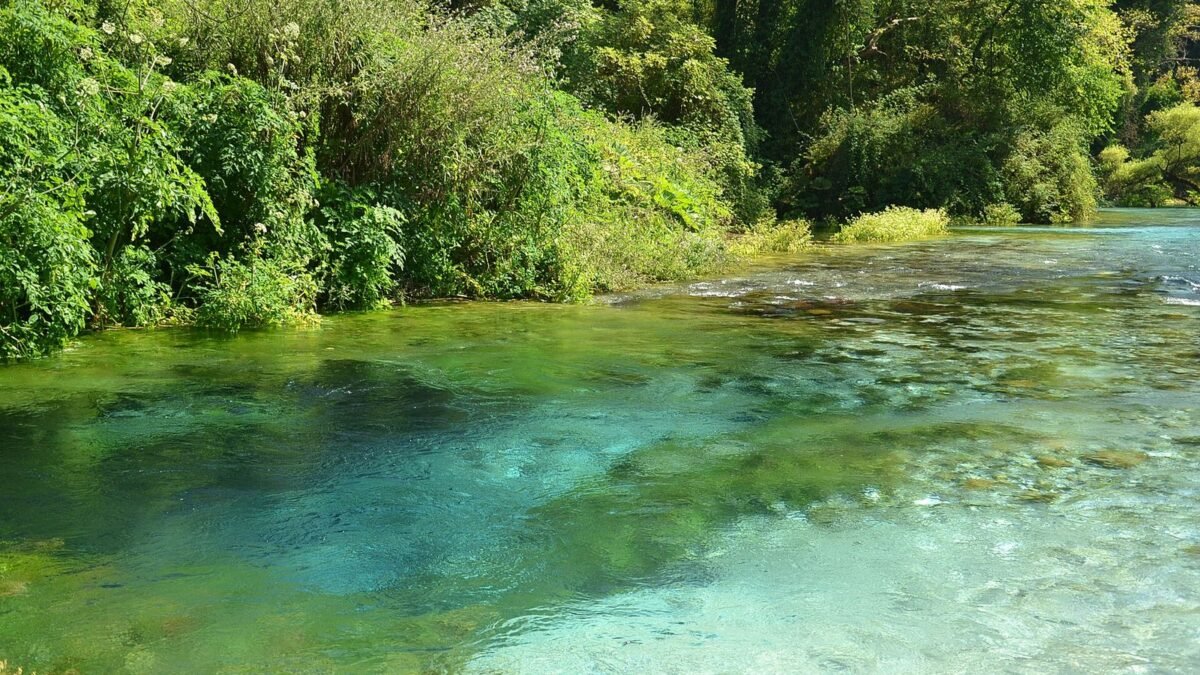
Because water drains quickly through the rock, many surface streams disappear into openings called sinkholes or ponors and flow underground, sometimes for long distances. They re-emerge as karst springs. The Buna spring near Mostar, flowing from beneath a cliff next to a dervish monastery at Blagaj, is one of the most famous. In Albania, the Blue Eye (Syri i Kaltër) near Sarandë is a deep karst spring whose bottom divers have struggled to reach.
Some karst fields, called poljes, flood in winter and dry out in summer, turning from lakes into farmland each year.
Caves and life underground
The region is rich in caves, home to unique animals adapted to darkness. The best known is the olm, a pale, blind amphibian that can live for decades and survive years without food. It lives only in the underground waters of the Dinaric Karst.
A fragile water supply
Karst aquifers supply drinking water to millions of people. But the same fissures that let water flow quickly also let pollution travel fast, with little natural filtering. Waste dumped into a sinkhole or sewage from a village can reach a spring used for drinking water within days. Tracing studies using harmless dyes are often the only way to know where underground water goes.
Protecting karst means controlling landfills, sewage, and fertiliser use far from the springs themselves, since the catchment may lie in another valley or even another country. For a region where rivers can cross borders underground, that requires cooperation as much as science.