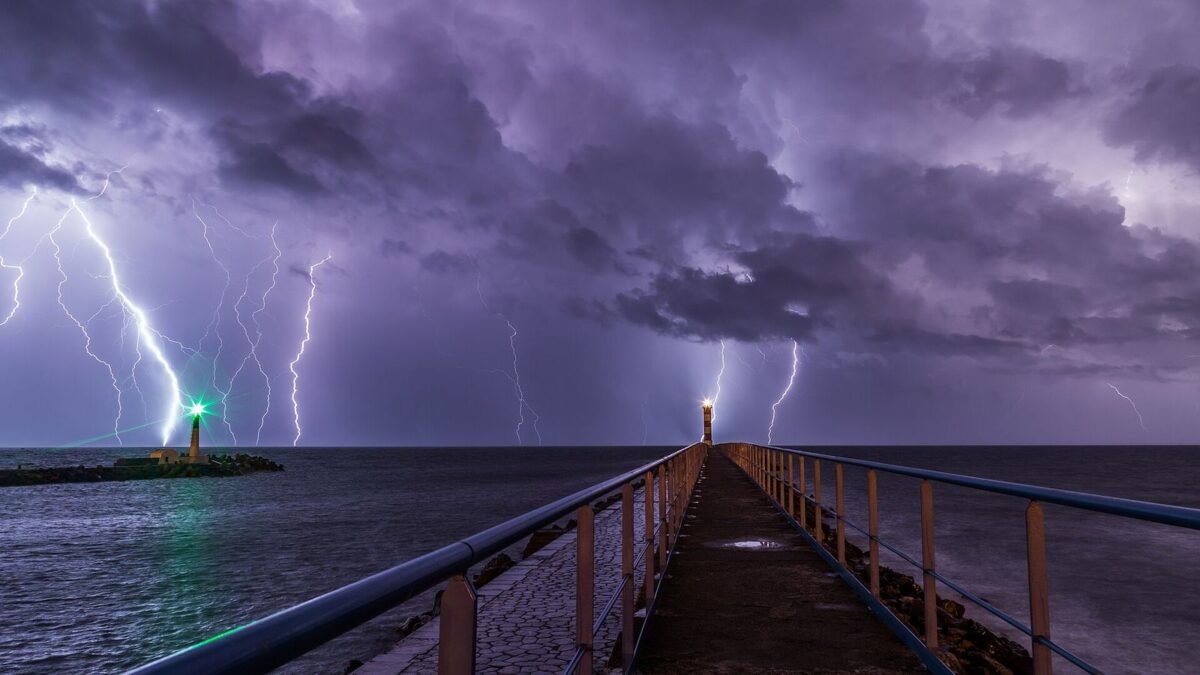
Summer thunderstorms are common across the Balkans, especially in the mountains in the afternoon. They bring spectacular lightning and, every year, injuries and deaths among hikers, farmers and people caught outdoors.
Building up charge
Thunderstorms form when warm, moist air rises rapidly and cools, forming tall cumulonimbus clouds that can reach heights of more than 10 kilometres. Inside, strong updrafts carry water droplets, ice crystals and soft hail called graupel. Collisions between these particles transfer electrical charge. Lighter ice crystals, usually positively charged, are carried to the top of the cloud, while heavier particles, usually negatively charged, gather lower down.
When the difference in charge becomes large enough, the air can no longer insulate it. A channel of ionised air forms, and electricity flows in a fraction of a second. Most lightning stays within or between clouds. Some reaches the ground.
Heat and thunder
A lightning channel can heat the air to around 30,000°C, several times hotter than the surface of the Sun. The air expands explosively, creating the shock wave we hear as thunder. Because light travels much faster than sound, counting the seconds between flash and thunder gives a rough distance: about three seconds per kilometre.
Where lightning strikes
Lightning tends to strike tall, isolated objects and high ground: mountain ridges, lone trees, towers and people in open fields. It can strike the same place more than once. It can also strike several kilometres ahead of a storm, sometimes from what looks like blue sky.
Staying safe
- If you hear thunder, you are close enough to be struck. Go indoors or into a hard-topped vehicle.
- Wait about 30 minutes after the last thunder before going back outside.
- In the mountains, plan to be off ridges and summits by early afternoon, when storms often build.
- If caught outside, avoid summits, isolated trees, water and metal fences. Move to lower ground and keep away from others in a group.
- Indoors, avoid using corded phones and touching plumbing during the storm.
Lightning victims do not carry an electrical charge and can be touched safely. Call 112 and start CPR if the person is not breathing; prompt help saves lives.