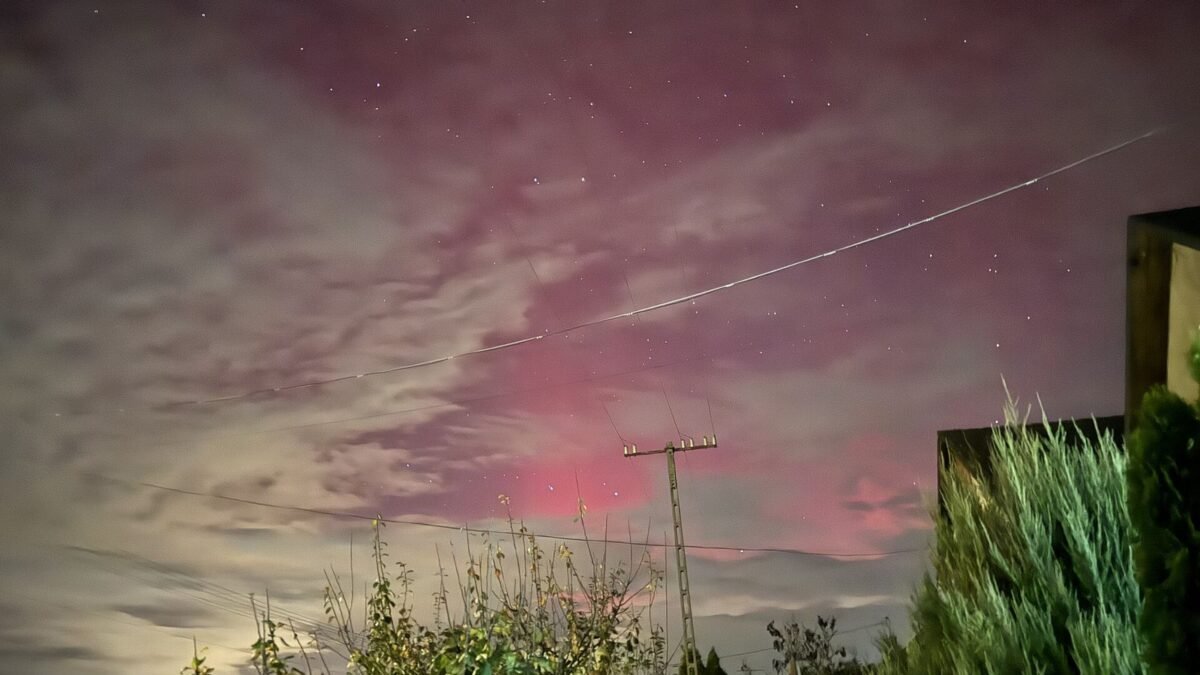
On the night of 10 May 2024, social media across the region filled with photographs of pink, red and green skies. People in Albania, Kosovo, North Macedonia, Serbia and beyond were seeing something normally reserved for Norway, Iceland or Finland: the northern lights. It was the result of the strongest geomagnetic storm in about two decades.
What an aurora is
The sun constantly sends out a stream of charged particles called the solar wind. Earth’s magnetic field deflects most of it, but some particles are channelled towards the regions around the magnetic poles. There, they collide with gases in the upper atmosphere, roughly 100 to 300 kilometres above the ground. The collisions give energy to oxygen and nitrogen atoms and molecules, which release it as light.
- Green, the most common colour, comes from oxygen at lower altitudes.
- Red comes from oxygen much higher up, and is typical of strong storms seen at lower latitudes.
- Blue and purple tones come from nitrogen.
Why they reached the Balkans
Normally, auroras form in an oval around the Arctic and Antarctic. During a powerful solar eruption, the sun can throw out a huge cloud of magnetised gas called a coronal mass ejection. If it hits Earth, it shakes the magnetic field and pushes the auroral oval much further towards the equator. In May 2024, several such eruptions arrived close together, and the storm reached the highest level on the scale used by space weather forecasters. That is why auroras were visible as far south as the Mediterranean.
The solar cycle
The sun’s activity rises and falls over a cycle of roughly eleven years. Around the peak, called solar maximum, there are more sunspots, more eruptions and more chances of strong storms. The current cycle has been particularly active in 2024 and 2025, which is why auroras have appeared far from the poles more often than usual.
Why phones see more than eyes
Many people in the Balkans discovered the aurora through their phone cameras. At low latitudes the light is often faint, and the human eye sees little colour in the dark. Modern phone cameras use long exposures and image processing that collect much more light, revealing pinks and greens that looked grey or invisible to the naked eye.
How to spot the next one
- Follow space weather alerts from national agencies or specialised apps, which track solar eruptions and forecast geomagnetic storms.
- Look north, away from city lights, ideally from a hill or open area.
- Choose a clear night and let your eyes adjust to the dark for at least 15 minutes.
- Use your phone’s night mode and keep it steady, resting it on something or using a small tripod.
More than a light show
Strong geomagnetic storms can also affect satellites, GPS accuracy, radio communication and power grids. Space weather forecasting has become an important field for that reason. For most people, however, a storm like the one in May 2024 is simply a rare chance to see one of nature’s most beautiful sights without travelling to the Arctic.